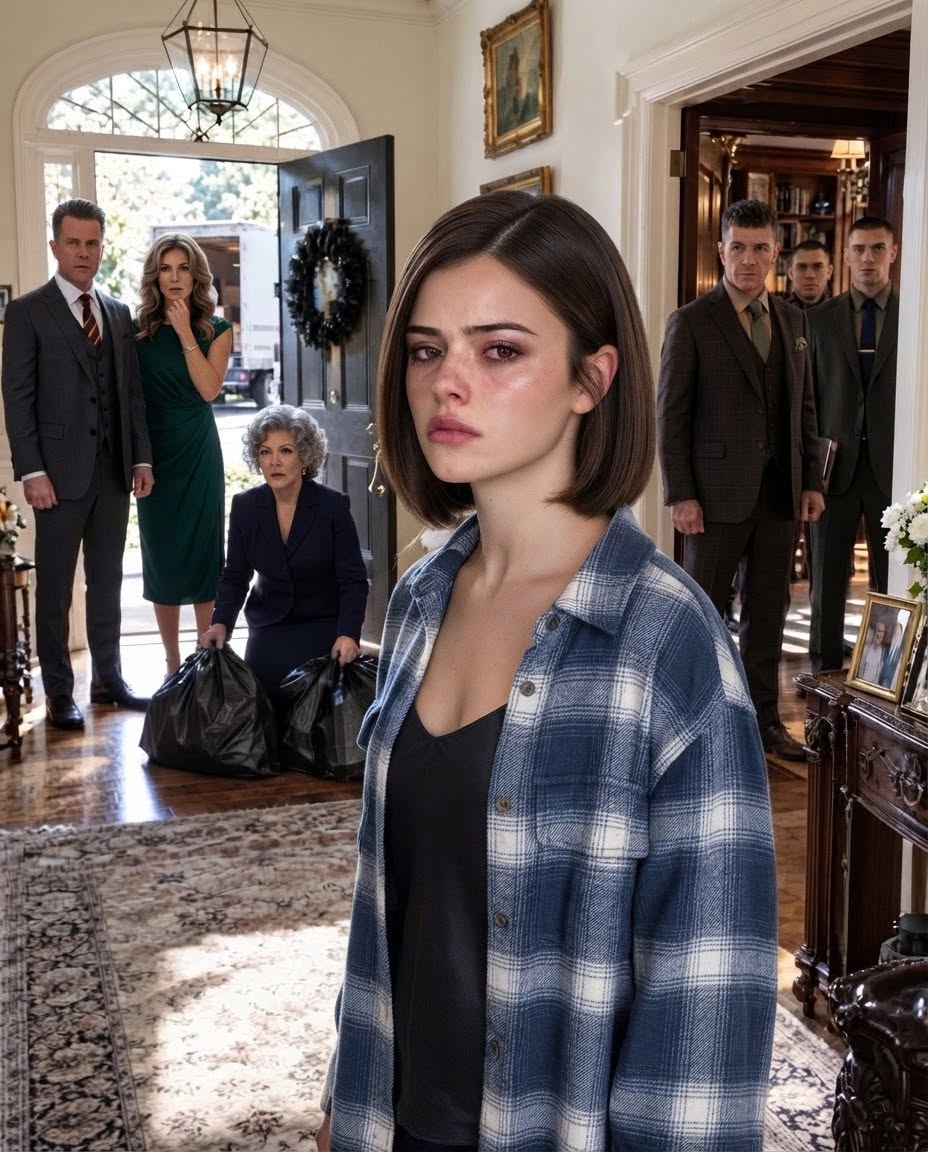
My parents left me with Grandpa when I was five years old and never came back. The morning after his funeral, they returned with a moving truck. My sister walked through the front door, looked around, and announced, “I’m taking the master bedroom.”
Mom shoved two black garbage bags into my hands.
“You were Grandpa’s responsibility,” she said. “Now that he’s gone, this house belongs to us.”
I didn’t argue.
There was no need.
Before Grandpa died, he had already told me exactly what to do when they came back.
And a few minutes later, when the door to his study opened, the garbage bags slipped from Mom’s hands.
It happened the morning after we buried him.
Seventeen years after my parents had dropped me off at Grandpa’s house and disappeared, they came back.
Not with flowers.
Not with condolences.
With a moving truck.
My sister Brianna climbed out behind them wearing oversized designer sunglasses.
She looked past the black funeral wreath still hanging on the front door, glanced up at the second floor, and smiled.
“I call the master bedroom.”
I stood on the porch wearing one of Grandpa’s old flannel shirts and holding a cup of coffee I hadn’t touched.
The house still smelled like funeral lilies and damp autumn air.
Underneath it was that familiar trace of pipe tobacco.
Grandpa had quit smoking ten years earlier, but somehow the scent had never fully left his coat pockets—or the walls of that house.
Mom climbed the steps like she already owned the place.
She looked me up and down.
“You look awful, Emily.”
She said it like she was criticizing my clothes.
Dad didn’t hug me.
He didn’t ask how I was doing.
He didn’t say he was sorry Grandpa was gone.
Instead, he turned toward the movers.
“Start upstairs. Take the furniture first.”
Brianna pushed past me into the foyer.
She wrinkled her nose.
“Seriously? This place smells like an old man.”
Something inside me became very still.
I had been five when my parents brought me to Grandpa’s house.
They told him I would stay for the weekend.
That weekend became seventeen years.
No birthday calls.
No Christmas cards.
No visits.
No explanation.
Grandpa raised me instead.
He did it with pension checks, vegetables from his garden, secondhand furniture, and bedtime stories about people who meant what they said.
Yesterday, I buried him.
Today, the people who abandoned me had come back to claim everything he left behind.
Mom snapped her fingers in front of me.
Then she pushed two garbage bags into my arms.
“Pack your things,” she said. “Clothes, toothbrush, that ugly quilt—whatever belongs to you.”
I stared at her.
Her voice dropped.
“You were Grandpa’s burden, Emily. He’s gone now. This house is ours.”
From upstairs, Brianna shouted,
“Mom! Can I paint the master bedroom white? This dark wood is depressing.”
Dad finally looked at me.
“Don’t make this difficult,” he said. “Your grandfather always wanted the property to stay in the family.”
Family.
I almost laughed.
Instead, I carefully set the garbage bags on the floor.
Because I remembered Grandpa’s last instructions.
A few days before he died, I had been sitting beside his hospital bed.
His hand was thin and weak in mine.
But his voice was still steady.
“When they come, don’t argue with them at the door.”
I frowned.
“When who comes?”
He already knew.
“Your parents.”
He squeezed my hand.
“Let them in.”
I leaned closer.
“Why?”
“Let them talk.”
He paused.
“Let them show everyone exactly who they are.”
I swallowed.
“And then?”
Grandpa looked straight at me.
“Open my study.”
That was all he said.
So when my parents arrived with a moving truck, I followed his instructions.
I didn’t yell.
I didn’t tell the movers to leave.
I didn’t argue when Brianna claimed the master bedroom.
I didn’t respond when Dad started giving orders.
And I said nothing when Mom called me a burden in the house where I had spent almost my entire childhood.
I just let them talk.
Let them assume.
Let them reveal exactly who they were.
Then a soft click came from the hallway.
Everyone stopped.
The door to Grandpa’s study slowly opened.
Mom turned toward it.
And the second she saw who was standing on the other side—
The garbage bags slipped from Mom’s hands.
One landed with a dull thud on the hardwood floor.
The other rolled toward the stairs.
Nobody moved.
Because standing in the doorway of Grandpa’s study wasn’t a stranger.
It was Mr. Harrison, Grandpa’s attorney.
He was holding a thick leather folder against his chest.
Behind him stood Mrs. Collins, the notary who had visited Grandpa several times during the last month of his life.
Mom stared at them as if she had seen a ghost.
“What are you doing here?”
Mr. Harrison didn’t answer her.
Instead, he looked at me.
“Emily,” he said gently, “your grandfather asked me to be here this morning.”
Mom stepped forward.
“This is a private family matter.”
“No,” Mr. Harrison replied calmly.
“It isn’t.”
He opened the folder.
“It is a legal matter.”
Dad’s expression changed.
“What exactly does that mean?”
Mr. Harrison looked at the movers.
“Please put everything down.”
Nobody moved.
He repeated himself.
“Every box. Every piece of furniture. Everything.”
One of the movers looked at Dad.
Dad hesitated.
Then he reluctantly nodded.
The house became strangely quiet.
Mr. Harrison turned to me.
“Emily, your grandfather’s will was finalized six months ago.”
Mom immediately interrupted.
“His will?”
“Yes.”
She laughed nervously.
“Well, obviously the house goes to his children.”
Mr. Harrison looked at her.
“Your father did not leave the house to you.”
Mom’s smile disappeared.
“What?”
“He left the entire property to Emily.”
Silence.
Brianna’s mouth fell open.
Dad stared at me.
Mom shook her head.
“No.”
Mr. Harrison continued.
“The house, the land, the savings account, the investment account, and the small rental property on Oak Street.”
Mom’s face became pale.
“That’s impossible.”
“It’s documented.”
She stepped toward him.
“My father would never do that.”
Mr. Harrison closed the folder.
“Actually, he was very clear.”
He looked at me.
“He wanted Emily to have a home that nobody could ever take away from her.”
My eyes burned.
I looked toward the study.
Grandpa’s words suddenly came back to me.
Let them in.
Let them talk.
Let them show everyone exactly who they are.
Mom turned toward me.
“You knew.”
I didn’t answer.
“You knew this whole time!”
“I knew Grandpa had a plan.”
“You let us walk in here?”
I looked at her.
“You walked in here because you thought you owned the place.”
Her face twisted with anger.
“You are nothing without him!”
For the first time that morning, I didn’t feel hurt.
I felt free.
“No, Mom.”
I shook my head.
“I was nothing to you.”
“But I was everything to him.”
Dad stepped between us.
“Emily, listen. We made mistakes.”
I almost laughed.
“Seventeen years isn’t a mistake.”
He looked down.
“We were young.”
“You were adults.”
“We didn’t know how to raise another child.”
I stared at him.
“You didn’t have to raise me.”
My voice cracked.
“You only had to visit.”
Nobody spoke.
I continued.
“You didn’t have to send money.”
“You didn’t have to buy me presents.”
“You didn’t have to pretend you were perfect parents.”
“You could have called.”
Mom looked away.
“And you didn’t.”
Brianna suddenly spoke.
“I didn’t know.”
I looked at her.
She removed her sunglasses.
For the first time that day, she looked less like the confident woman who had claimed the master bedroom and more like a frightened daughter who had just discovered how much her parents had hidden from her.
“Mom told me Grandpa wanted the house to stay with the family,” she said.
I nodded.
“It is staying with the family.”
She looked confused.
“Just not the family you thought.”
Mr. Harrison cleared his throat.
“There is something else.”
Mom’s expression hardened.
“What now?”
He opened the folder again.
“Your father left instructions concerning the circumstances of Emily’s childhood.”
Dad froze.
Mr. Harrison looked directly at him.
“Specifically, he documented every attempt he made to contact you after Emily was left in his care.”
Mom’s lips parted.
“He contacted you repeatedly.”
Dad said nothing.
“Letters.”
“Phone calls.”
“Registered mail.”
“Even a private investigator.”
My heart stopped.
I had never known that.
Mr. Harrison continued.
“Your grandfather wanted to know why you had abandoned your daughter.”
Dad finally spoke.
“We had financial problems.”
Mr. Harrison shook his head.
“That was not the explanation you gave him.”
He pulled another document from the folder.
“You told him you intended to return after you had stabilized your lives.”
He looked at Dad.
“You never did.”
Mom suddenly whispered,
“How much money did he leave her?”
Mr. Harrison looked at her.
“That isn’t relevant.”
“It is to me.”
“No,” I said.
“It’s not.”
Mom stared at me.
For once, I wasn’t afraid of her.
I walked toward the staircase.
Brianna moved aside.
I stopped beside her.
“You can have the bedroom.”
She looked surprised.
“What?”
“The master bedroom.”
I smiled faintly.
“I don’t want it.”
She stared at me.
“Why?”
“Because Grandpa’s room is downstairs.”
I looked toward the hallway.
“That’s where I’m staying.”
Then I turned back to Mr. Harrison.
“Is there anything else?”
He smiled.
“Yes.”
He reached into the folder and handed me a small envelope.
“Your grandfather asked me to give you this only after your parents arrived and you followed his instructions.”
My hands trembled as I opened it.
Inside was a single handwritten note.
Emily,
If you’re reading this, then they came back.
I wish I could be there to see your face.
Don’t waste your heart trying to make them love you.
You spent too many years wondering why they left.
The truth is simple.
Their leaving was never a reflection of your worth.
It was a reflection of theirs.
You were never a burden.
You were the best thing that ever happened to me.
This house is not your reward.
It is your beginning.
Build something here.
Fill these rooms with people who choose to stay.
And when you have children of your own someday, give them what I gave you.
A home where they never have to wonder if they belong.
Love,
Grandpa.
I couldn’t see the rest of the room through my tears.
Mr. Harrison quietly stepped away.
Mom watched me.
For several seconds, neither of us spoke.
Then she said something I never expected.
“I’m sorry.”
I looked at her.
She was crying.
Maybe the apology was real.
Maybe it wasn’t.
For the first time, I realized it didn’t matter.
I didn’t need her apology to heal.
I didn’t need her approval to move forward.
I didn’t need her to finally become the mother I had wanted when I was five years old.
I had already been loved.
Grandpa had made sure of that.
Dad approached me.
“Can we talk?”
I shook my head.
“Not today.”
He nodded slowly.
Maybe he finally understood.
The movers left without taking a single thing.
Mom and Dad followed them.
Brianna remained at the doorway.
She looked back at me.
“I’m sorry, Emily.”
I nodded.
“Take care of yourself.”
She gave me a small smile.
Then she left too.
The front door closed behind them.
For the first time in seventeen years, I watched my parents leave my life without wondering whether they would ever come back.
I knew they might.
But something had changed.
They no longer had the power to decide where I belonged.
That decision was finally mine.
I stood in the foyer for a long time.
Then I walked into Grandpa’s study.
His old desk was still there.
His glasses were sitting beside an unopened book.
His chair was pushed slightly backward, as if he had just stood up and might return at any moment.
I sat down.
For the first time since his funeral, I let myself cry.
Not because I had lost everything.
Because I had finally realized I hadn’t.
I still had the house.
I still had the memories.
I still had the lessons he had given me.
And most importantly, I still had the future he wanted me to build.
Six months later, I opened Grandpa’s front door again.
But this time, I wasn’t waiting for my parents.
I was welcoming children from the local foster program.
I had turned the downstairs living room into a small reading room.
There were shelves of books along the walls.
A long wooden table stood where Grandpa’s old television had been.
The refrigerator was always filled with snacks.
And above the fireplace hung a photograph of Grandpa.
Underneath it was a simple wooden sign.
“Everyone Belongs Somewhere.”
It became the name of the little community center I built in his memory.
Grandpa’s study remained untouched.
His desk.
His chair.
His glasses.
Even the old pipe he hadn’t touched in years.
Sometimes, after everyone had gone home, I’d sit there alone and read his letter again.
And every time I reached the same words, I cried.
You were never a burden.
You were the best thing that ever happened to me.
Years later, people sometimes asked why I never sold the house.
My answer was always the same.
“Because Grandpa didn’t leave me a house.”
“He left me a home.”
And when people asked about my parents, I no longer felt anger.
I simply told them the truth.
“They were part of my story.”
“But they were never the ending.”
Because when I was five years old, my parents thought they were leaving behind a child who had nowhere to go.
They were wrong.
They left me with the one person who taught me what love actually looked like.
And seventeen years later, when they came back expecting to take everything Grandpa had built—
they discovered something he had understood long before I did.
A home isn’t defined by the people who claim to own it.
It’s defined by the people who make you feel like you belong.
Grandpa gave me that.
And in the end, that was the one thing nobody could ever take away from me.